MeDo

KI-Footer-Generator.

Beschreiben Sie den Footer, den Sie brauchen — Spalten, Links, Rechtstexte, Social-Icons — und MeDo generiert produktionsfertigen Code in Sekunden. Nie wieder Boilerplate kopieren.

Footer
Footer

Jede Website verdient einen Footer, der seinen Platz rechtfertigt.

Ein Footer ist keine Nachbetrachtung — es ist der Ort, wo Nutzer suchen, wenn sie tiefer gehen, rechtliche Informationen finden oder Ihnen in sozialen Netzwerken folgen möchten. Ein gut strukturierter Footer schafft Vertrauen, verbessert die SEO durch interne Verlinkung und verwandelt jede Seite in eine Conversion-Möglichkeit. Trotzdem werden die meisten Footer in letzter Minute zusammengeworfen. MeDo macht es einfach, einen Footer zu generieren, der wirklich funktioniert.

7 Vorlagen

Footer-Vorlagen, die Sie generieren können

Jede Vorlage ist ein echter Prompt, kein Screenshot. Kopieren Sie ihn in einen KI-Editor oder führen Sie ihn in MeDo aus und erhalten Sie React- und Tailwind-Code zurück.

Utility miniAnchor

Wordmark, Links, Copyright Row

The minimum that still qualifies as a footer. Use it when the page above is already doing the persuading and the footer just has to close the document.

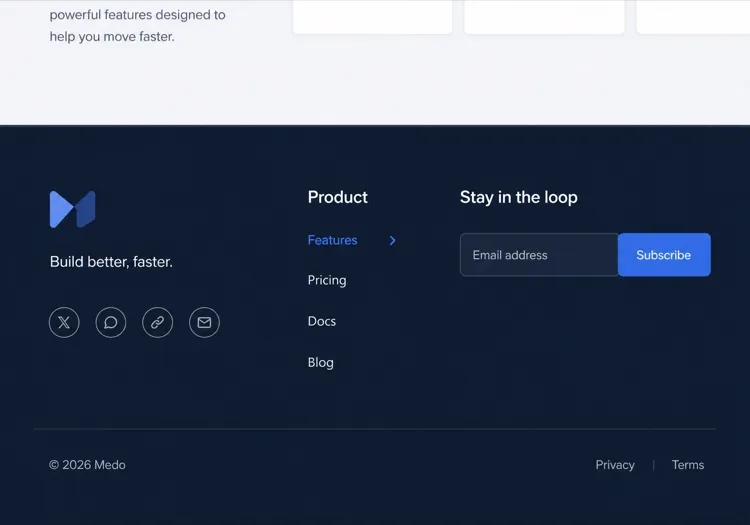
Create a minimal website footer: a wordmark on the left, a single row of five utility links (Work, About, Journal, Careers, Contact) on the right, and a thin top border. Below it, a copyright line with Privacy, Terms and Cookies links in muted text. Stack the wordmark above the links on mobile.
In MeDo testen
Multi-columnAcme

Four-Column SaaS Site Map

The workhorse. A brand block plus Product, Company, Resources and Legal columns — the layout that reads as "serious product" to a first-time visitor.

Create a four-column website footer with a brand block on the left containing a logo, a one-line tagline and three social icons. Then four link columns headed Product, Company, Resources and Legal, three to four links each. Add a bottom row with the copyright line and Privacy, Terms and Cookies links. Collapse to two columns on tablet and one on mobile.

In MeDo testen
Site map + newsletterMega

Full Site Map With Email Capture

For content-heavy marketing sites where footer link depth matters for crawling and the newsletter is a real acquisition channel.

Create a mega footer with a full site map: four link columns headed Product, Solutions, Resources and Company with four links each, plus a newsletter block on the right with a heading, one line of supporting copy, an email input and a Subscribe button. Bottom row shows the copyright with city and Privacy, Terms and Cookies links.

In MeDo testen
CTA-toppedShipfast

Dark Footer With a CTA Card

The footer becomes the page's second closer: one action on top, the link grid beneath it, legal at the base.

Create a dark website footer that opens with a CTA card: a short heading, a reassurance line about no credit card required, and a primary Get started button. Below the card, four link columns headed Product, Company, Resources and Legal. Close with a copyright row and Privacy, Terms and DPA links. Use an inverted dark surface with light text.

In MeDo testen
Newsletter-ledBuilders

Email Capture Above the Link Grid

Turns the bottom of a blog or docs site into a subscription surface. The link grid still ships, just below the capture.

Create a newsletter-led footer: at the top, a heading with a subscriber count, a one-line no-spam promise, an email input and a Subscribe button. Below it, four link columns headed Explore, Docs, Community and Support. Close with a social icon row and a copyright line.

In MeDo testen
Contact-firstStudio

Address, Phone and Email Footer

For agencies and local businesses, where the footer answers "how do I reach you" without a click through to a contact page.

Create a contact-first footer for a design studio: a brand block with a name and one-line description, then three contact columns headed Visit (street address and city), Call (phone number and opening hours) and Email (two addresses). Close with a copyright row and Privacy, Terms and Cookies links.

In MeDo testen
Brand-ledBrand*

Oversized Wordmark and Mini Nav

The last thing the visitor reads is the brand. One oversized logotype, a tagline, a social row and four utility links.

Create a brand-led footer with an oversized lowercase wordmark filling most of the footer width, a one-line studio tagline with the founding year and city underneath, a row of social links, and a mini utility nav with Work, About, Journal and Contact. Close with a single small copyright line.

In MeDo testen

So passen Sie Ihre Footer an

Ihre Markenfarben anpassen

Footer verwenden oft ein invertiertes Farbschema — probieren Sie einen dunklen Hintergrund mit hellem Text, um die Seite visuell zu verankern, oder bleiben Sie konsistent mit Ihrem Site-Theme. Geben Sie genaue Farben in Ihrem Prompt an.

Das Spaltenlayout steuern

Zwei bis vier Spalten sind ideal. Sagen Sie MeDo, wie viele Spalten Sie möchten und was jede enthält — Navigationslinks, Kontaktinformationen, Social-Icons oder ein Newsletter-Formular.

Newsletter-Anmeldung hinzufügen

Footer sind erstklassige Immobilien für E-Mail-Erfassung. Bitten Sie MeDo, ein Inline-E-Mail-Eingabefeld und einen CTA-Button einzufügen, um jeden Seitenabgang in einen potenziellen Abonnenten zu verwandeln.

Rechtstexte korrekt halten

Aktualisieren Sie das automatisch generierte Copyright-Jahr und den Firmennamen vor dem Veröffentlichen. Geben Sie MeDo Ihren genauen Firmennamen und Rechtsraum an, um den richtigen Rechtstext-Platzhalter zu erhalten.

Wer die Footer-Komponente nutzt

SaaS-Produkt

Produktlinks, Dokumentation, Changelog, Support, Social-Icons und eine Datenschutz-/Nutzungsbedingungen-Zeile — ein vollständiger Footer, der Power-User führt und rechtliche Anforderungen erfüllt.

Marketing- / Landingpage

Minimaler Footer mit Markenlogo, einigen wichtigen Links und einem CTA. Hält Besucher auf die Conversion fokussiert und bietet dabei die erwartete Navigation.

E-Commerce-Shop

Kundenservice-Links, Versandrichtlinie, Rückgaberecht, Vertrauenszeichen und Zahlungsicons. Footer im E-Commerce reduzieren direkt die Kaufangst.

Portfolio oder persönliche Website

Social-Links, Kontakt-E-Mail und eine kurze Bio-Zeile. Einfach, professionell und persönlich — mit einem Prompt generiert.

Footer-Muster für verschiedene Websites

Dieselbe footer-Komponente, abgestimmt auf die Art der Website, auf der sie läuft.

01 / 06

SaaS Product Footer

Group links by user intent rather than by internal org chart — Features, Pricing, Docs, Status, Security. A brand block on the left gives the eye somewhere to land before it scans the columns, and a Status link in the footer saves your support inbox on incident days.

Footer-Stile und -Varianten

Wählen Sie die Variante, die zum Rest der Seite passt, und generieren Sie sie.

01 / 06

Minimal Footer

A wordmark, one row of utility links and a copyright line. The right default when the page above is carrying the weight, and the safest choice for a single-page site where a four-column site map would be mostly empty.

Footer in React, Next.js, Vue und Svelte

React, Next.js, Vue 3, SvelteKit, Astro oder reines HTML — dieselbe footer, sechs Wege zur Einbindung.

01 / 06

React Footer

A plain function component with no client state — a link-only footer never needs hooks. Mount it in your root layout rather than in each page so the markup exists exactly once.

src/components/Footer.tsx

export function Footer() {
  return (
    <footer className="border-t bg-zinc-950 py-12">
      {/* brand block + link grid */}
    </footer>
  )
}

So fügen Sie Ihre Footer einem Projekt hinzu

Vier Schritte, von der Auswahl einer footer-Vorlage bis zum Einsatz in der Produktion.

01~30s

Pick a Footer Template

Scan the templates above and pick the one matching your page weight — minimal for a landing page, multi-column for a product, contact-first for an agency.

02~10s

Copy the Prompt

Take the prompt straight from the card into MeDo, or paste it into Lovable, Bolt, v0 or Cursor. Edit the link names to match your real information architecture before you run it.

03~1min

Generate and Refine

You get React + Tailwind back with a live preview. Follow up in plain English — "make it two columns on tablet", "add a status link" — instead of hand-editing class strings.

04~1min

Mount It in Your Layout

Drop the component into your root layout — app/layout.tsx, +layout.svelte, __root.tsx — so it renders once on every route rather than being pasted per page.

Häufige Fragen zu Footer

Wie erstelle ich einen Website-Footer mit KI?

In MeDo beschreiben Sie den Footer, den Sie brauchen — Anzahl der Spalten, welche Links einzufügen sind, Farbschema und besondere Elemente wie ein Newsletter-Formular oder Social-Icons. MeDo generiert den vollständigen Komponenten-Code, den Sie in Ihr Projekt kopieren oder mit weiteren Prompts verfeinern können.

Was ist der beste KI-Footer-Generator?

MeDo ist speziell für die Generierung produktionsfertiger Website-Komponenten einschließlich Footer entwickelt. Im Gegensatz zu generischen KI-Chat-Tools versteht MeDo Layout, Responsiveness und reale Textanforderungen — sodass Sie sauberen, nutzbaren Code erhalten.

Kann ich mit KI einen responsiven Footer generieren?

Ja. MeDo generiert mobile-first Komponenten. Erwähnen Sie einfach "mobilfreundlich" oder "responsiv" in Ihrem Prompt, und der generierte Footer stapelt die Spalten auf kleineren Bildschirmen korrekt.

Wie füge ich Social-Media-Icons zu einem KI-generierten Footer hinzu?

Fügen Sie einfach die Social-Plattformen in Ihren Prompt ein — zum Beispiel "füge Twitter-, LinkedIn- und GitHub-Icons in den Footer ein." MeDo wird sie mit barrierefreien Labels und Link-Platzhaltern einfügen.

Kann ich KI verwenden, um Footer-Navigationslinks zu generieren?

Absolut. Listen Sie die gewünschten Links in Ihrem Prompt auf (z.B. "Links zu Über uns, Blog, Preise und Kontakt") und MeDo strukturiert sie in eine saubere Navigationsspalte mit korrekter HTML-Semantik.

Enthält der KI-Footer-Generator einen Copyright-Hinweis?

Ja — MeDo fügt standardmäßig eine Copyright-Zeile ein. Sie können Ihren Firmennamen, das Jahr oder den bevorzugten Wortlaut im Prompt angeben, der dann in der generierten Ausgabe erscheint.