MeDo

KI-Header-Generator.

Beschreiben Sie den Kopf Ihrer Seite und MeDo baut den gesamten Streifen — Logo und Marken-Lockup, eine optionale Ankündigungsleiste darüber, Sticky-Scroll-Verhalten mit Frosted-Glass-Blur und den CTA. Die Navigationslinks leben darin; der Header ist alles, was sie einrahmt.

Header
Header

Der Header ist die einzige Komponente auf jeder einzelnen Seite

Was sich zwischen Landingpage, Dokumentation und Checkout-Flow auch ändert — der Header bleibt konstant. Das macht ihn zum Element, das die Markenidentität trägt, und gleichzeitig zur teuersten Stelle für Performance-Fehler: Ein Header, der sich beim Laden der Schriften verschiebt oder vor der Hydration keine Höhe reserviert, erzeugt Layout-Shift auf jeder Seite, die ein Besucher sieht, nicht nur auf einer. Beim Sticky-Verhalten gilt derselbe Multiplikator. Ein Blur, der in jedem Scroll-Frame neu gezeichnet wird, kostet Sie website-weit Geschmeidigkeit. Weil er einmal generiert und überall verwendet wird, lohnt es sich, den Header im Prompt überspezifiziert zu beschreiben.

6 Vorlagen

Header-Vorlagen, die Sie generieren können

Jede Vorlage ist ein echter Prompt, kein Screenshot. Kopieren Sie ihn in einen KI-Editor oder führen Sie ihn in MeDo aus und erhalten Sie React- und Tailwind-Code zurück.

Fixed heightAcme

Sticky Header With a Frosted Scroll State

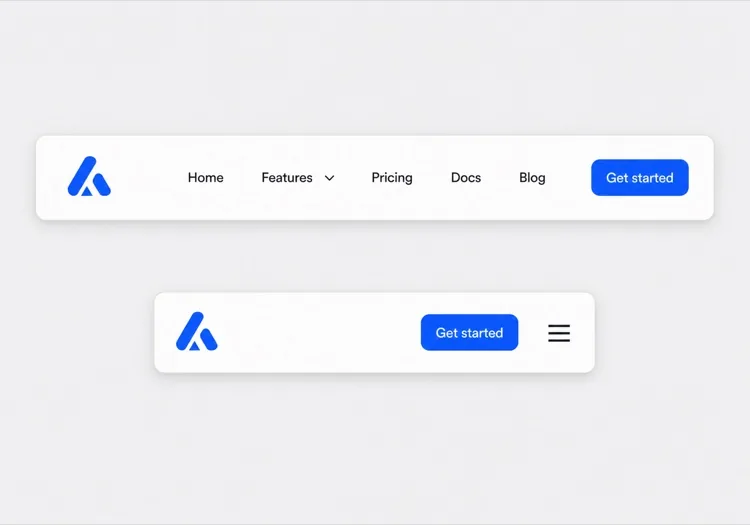
The default worth starting from: a pinned height and a blur that only appears once you have scrolled. Specifying the height is the whole point — a header that sizes to its content shifts on every page as the webfont swaps in.

Create a sticky website header with an explicit 64px height set on the container so the space is reserved before the logo and webfonts load. Logo mark plus wordmark on the left, four navigation links in the middle, one filled Get started button on the right. Start with a solid white background and a 1px bottom border, then switch to a semi-transparent surface with a backdrop blur once the page scrolls past 80px, transitioning over 200ms. Drive the state from an IntersectionObserver watching a 1px sentinel above the header rather than a scroll listener, so nothing runs on the scroll thread. Below 768px, replace the links with a hamburger that opens a drawer.
In MeDo testen
Announcement barMega

Promo Bar Above a Sticky Row

Two stacked strips where only the lower one stays pinned. The trap is the sticky offset: dismiss the bar without recomputing it and the header floats 36px below the viewport top for the rest of the session.

Create a two-part header: a dismissible 36px announcement bar on an accent background with a short promo line, an inline link and a close button, and beneath it a 64px main row with logo, links and a CTA. Only the main row is sticky. Persist the dismissal in localStorage so the bar does not return on the next page, and recompute the sticky top offset when it is removed so the main row still pins flush to the viewport top. Render the bar server-side and hide it with a class rather than mounting it after hydration, so dismissing it never causes a visible reflow of the page below.

In MeDo testen
TransparentShipfast

Transparent Over Hero, Solid on Scroll

For landing pages with a full-bleed hero behind the header. Everything that depends on the background — logo variant, link color, border, button style — has to flip in one state change, not four.

Create a header that overlays a full-bleed hero image: fully transparent with no border at the top of the page, with a light logo variant and white links. Once the page scrolls past the hero height, switch in a single state change to a solid white surface, a dark logo variant, dark links and a 1px bottom border, transitioning over 200ms. Keep the header height fixed at 72px in both states so the switch does not move the links. Add a scroll-margin-top equal to the header height on all headings so in-page anchors do not land behind the bar.

In MeDo testen
Two-rowShop

Utility Row Over a Sticky Search Row

A storefront header where the top row scrolls away and the search row stays. Pinning both eats 100px of a phone viewport, which is most of a product image.

Create a two-row e-commerce header. The top row, 32px tall, carries a free-shipping message on the left and Track order, Help and account links on the right, and scrolls away with the page. The bottom row, 64px tall, holds the logo, a wide search input, a wishlist icon and a cart button with a count badge, and is the only row that stays sticky. Announce cart count changes through an aria-live="polite" region. Below 768px, collapse the top row entirely, keep logo, search icon and cart in the sticky row, and open search as a full-width overlay when the icon is tapped.

In MeDo testen
App shellDocs

Fixed Header With a Sidebar Toggle

A docs header that has to coordinate with a sidebar below it. Reserve the toggle button's space at every breakpoint, otherwise the logo jumps sideways when the button appears at the tablet threshold.

Create a fixed 56px documentation header: a sidebar toggle button on the far left that is only interactive below 1024px but keeps its 40px slot reserved at every breakpoint so the logo never shifts, then the logo, a version switcher, a search button with a Command-K hint, a theme toggle and a GitHub link. Because the header is fixed rather than sticky, add matching top padding to the page body and set scroll-margin-top on every heading so deep links from search land below the bar. Give the toggle aria-expanded and aria-controls pointing at the sidebar element.

In MeDo testen
StaticStudio

Oversized Wordmark, No Sticky

Not everything needs to be pinned. A tall static header that scrolls away gives an agency site its full viewport back, and removes the scroll listener along with it.

Create a static header for a design studio that scrolls away with the page rather than sticking: 120px tall, with an oversized lowercase wordmark on the left, a one-line location and availability note beneath it, and four right-aligned links in a light weight with wide letter spacing. No border, no background change, no scroll listener at all. Below 640px, reduce the height to 80px, keep the wordmark, and move the four links into a full-screen overlay opened by a text Menu button — labelled Menu rather than a hamburger icon, and closing on Escape with focus returned to the button.

In MeDo testen

So passen Sie Ihre Header an

Legen Sie die Höhe fest, bevor Sie irgendetwas stylen

Fordern Sie eine explizite Header-Höhe an. Das kostet eine Zeile und beseitigt den Layout-Shift, der sonst auf jeder Seite beim Laden von Logo und Webfonts auftritt — die häufigste Core Web Vitals-Regression, die auf einen Header zurückgeht.

Drosseln Sie den Scroll-Zustand

Ein Backdrop-Blur, der über einen rohen Scroll-Listener umgeschaltet wird, zeichnet dutzende Male pro Sekunde neu. Geben Sie an, dass der Scroll-Handler mit requestAnimationFrame gedrosselt oder von einem IntersectionObserver-Sentinel gesteuert werden soll, damit das Scrollen auch auf Mittelklasse-Hardware flüssig bleibt.

Behandeln Sie die Ankündigungsleiste als Teil des Headers

Wenn Sie einen Promo-Streifen über der Hauptzeile möchten, beschreiben Sie ihn im selben Prompt, damit seine Höhe im Sticky-Offset berücksichtigt wird. Nachträglich angeflanscht verdeckt er entweder Inhalte oder zählt seine Höhe nach dem Schließen doppelt.

Beschreiben Sie das Marken-Lockup präzise

Sagen Sie, ob Sie nur eine Bildmarke, eine Bildmarke plus Wortmarke oder eine Wortmarke wollen, die auf kleinen Bildschirmen auf die Bildmarke reduziert wird. Der Header ist die eine Komponente auf jeder Seite — hier wird Markenkonsistenz entweder durchgesetzt oder verloren.

Wer die Header-Komponente nutzt

SaaS-Produktseite

Ein 64px hoher weißer Header mit fester Höhe, einem Frosted-Blur nach dem Scrollen und einer schließbaren Ankündigungsleiste darüber, die für die Dauer der Kampagne eine Launch-Promo ausspielt.

E-Commerce-Shop

Ein zweizeiliger Header, dessen obere Zeile ein Gratis-Versand-Banner und Account-Links trägt und dessen untere Zeile Suche und Warenkorb enthält, wobei nur die untere Zeile beim Scrollen sticky bleibt.

Marketing- oder Landingpage

Ein transparenter Header über einem randlosen Hero-Bild, der beim Scrollen zu einem soliden Hintergrund wechselt, wobei das Logo am selben Breakpoint von einer hellen zu einer dunklen Variante springt.

Entwickler-Dokumentationsseite

Ein fixierter Header mit Versions-Umschalter und Suche-Trigger sowie einem Sidebar-Toggle, der unterhalb des Tablet-Breakpoints erscheint und eigenen Platz reserviert, damit der Docs-Inhalt nie umbricht.

Header-Muster für verschiedene Websites

Dieselbe header-Komponente, abgestimmt auf die Art der Website, auf der sie läuft.

01 / 06

SaaS Product Header

One fixed-height sticky strip with a brand lockup, links and a single CTA. Because it renders on every route, any layout shift here is multiplied across your whole Core Web Vitals field data rather than isolated to the landing page.

Header-Stile und -Varianten

Wählen Sie die Variante, die zum Rest der Seite passt, und generieren Sie sie.

01 / 06

Fixed-Height Sticky Header

An explicit height on the container, pinned to the top. The height is not a styling detail — without it the strip resizes as the logo and webfonts resolve, and that shift lands on every page a visitor opens.

Header in React, Next.js, Vue und Svelte

React, Next.js, Vue 3, SvelteKit, Astro oder reines HTML — dieselbe header, sechs Wege zur Einbindung.

01 / 06

React Header

Keep the scroll state in the header itself with an IntersectionObserver on a sentinel div, not a scroll listener. Render it once above your router outlet so the observer is created once per session.

src/components/Header.tsx

export function Header() {
  const [pinned, setPinned] = useState(false)
  const ref = useRef(null)

  useEffect(() => {
    const io = new IntersectionObserver(
      ([e]) => setPinned(!e.isIntersecting)
    )
    io.observe(ref.current)
    return () => io.disconnect()
  }, [])

  return <header className={pinned ? 'backdrop-blur' : ''} />
}

So fügen Sie Ihre Header einem Projekt hinzu

Vier Schritte, von der Auswahl einer header-Vorlage bis zum Einsatz in der Produktion.

01~30s

Pick a Header Template

Decide two things first: does the strip stay pinned, and is there an announcement bar. Those choices drive the sticky offset and the scroll state, and they are the awkward ones to retrofit.

02~10s

Copy the Prompt

Paste it into MeDo, Lovable, Bolt, v0 or Cursor. Keep the explicit pixel height and the sentinel-based scroll state in the text — those two sentences are what stop the header shifting and repainting on every page.

03~1min

Generate and Refine

You get React + Tailwind back with a live preview. Follow up in plain English — "make the blur stronger", "persist the dismissed announcement bar", "flip the logo variant on scroll".

04~2min

Mount It in Your Layout

Put the header above {children} in your root layout. If it is fixed rather than sticky, add matching top padding to the body and scroll-margin-top to your headings so anchor links do not land underneath it.

Häufige Fragen zu Header

Was ist ein KI-Header-Generator?

Ein KI-Header-Generator ist ein Tool, das eine natürlichsprachliche Beschreibung Ihrer Website nimmt und automatisch HTML, CSS und JavaScript für eine vollständige, gestaltete Header-Komponente erstellt. Anstatt Layout-Code von Grund auf zu schreiben, beschreiben Sie, was Sie möchten, und erhalten funktionierenden Code zurück.

Wie erstelle ich einen Website-Header mit KI?

Öffnen Sie MeDo, geben Sie einen Prompt wie "Erstelle einen Sticky-Header für eine Designagentur mit Logo links, Links für Arbeit, Über uns und Kontakt, und einem 'Lass uns reden'-Button rechts" ein, und MeDo generiert die vollständige Komponente. Sie können dann den Code kopieren oder ihn mit Follow-up-Prompts weiter bearbeiten.

Kann ich mit KI einen responsiven Header generieren?

Ja. MeDo generiert standardmäßig Mobile-First-Header. Teilen Sie ihm die Breakpoints oder Geräte mit, die Sie benötigen — "lass es unter 768px zu einem Hamburger-Menü zusammenfallen" — und es verwaltet die responsive Logik für Sie.

Was ist der Unterschied zwischen einem Header und einer Navbar?

Der Header ist der volle Streifen oben auf jeder Seite: Marken-Lockup, optionale Ankündigungsleiste, Sticky- und Scroll-Verhalten sowie der Container, der alles zusammenhält. Die Navbar sind die Navigationslinks darin. Bauen Sie den Header, wenn es Ihnen darum geht, wie der Seitenkopf website-weit aussieht und sich verhält; sehen Sie sich den KI-Navbar-Generator an, wenn es Ihnen eigentlich um Linkstruktur, Dropdowns und das mobile Menü geht.

Wie verhindere ich, dass mein Header Layout-Shift verursacht?

Geben Sie dem Header im Prompt eine explizite Höhe, damit der Browser den Platz reserviert, bevor Schriften und Logo laden, und reservieren Sie Raum für eine etwaige Ankündigungsleiste, statt sie den Inhalt nach der Hydration nach unten zu schieben. Ist der Header fixed statt sticky, ergänzen Sie ein passendes Top-Padding am Seitenkörper. Bitten Sie MeDo um eine feste Header-Höhe, und es setzt beides um.

Was ist das beste KI-Tool zur Generierung von Website-Headern?

MeDo ist speziell für die Generierung einzelner Website-Komponenten aus Prompts gebaut, einschließlich Header. Im Gegensatz zu allgemeinen KI-Chat-Tools versteht MeDo Komponentenstruktur, Barrierefreiheitsanforderungen und reale UX-Muster — sodass das Ergebnis näher daran ist, was ein erfahrener Frontend-Entwickler liefern würde.