MeDo

Gerador de Hero Section com IA.

Escreva uma frase sobre o que você está construindo e receba um hero completo above-the-fold — título, subtítulo, call-to-action e layout — pronto para publicar.

Hero Section
Hero Section

Todo site se decide nos primeiros cinco segundos

A hero section é o espaço mais examinado de qualquer página web — é onde visitantes decidem em segundos se ficam, rolam ou saem. Um título claro que nomeia o valor, um subtítulo que gera confiança e um CTA que elimina atrito podem dobrar o tempo na página e as inscrições de teste sem mudar mais nada. Domine o hero, e cada seção abaixo recebe um público mais receptivo.

6 modelos

Modelos de Hero Section que você pode gerar

Cada modelo é um prompt real, não uma captura de tela. Copie para qualquer editor de IA, ou rode no MeDo e receba código React + Tailwind.

Split screenAcme

Copy Left, Product Screenshot Right

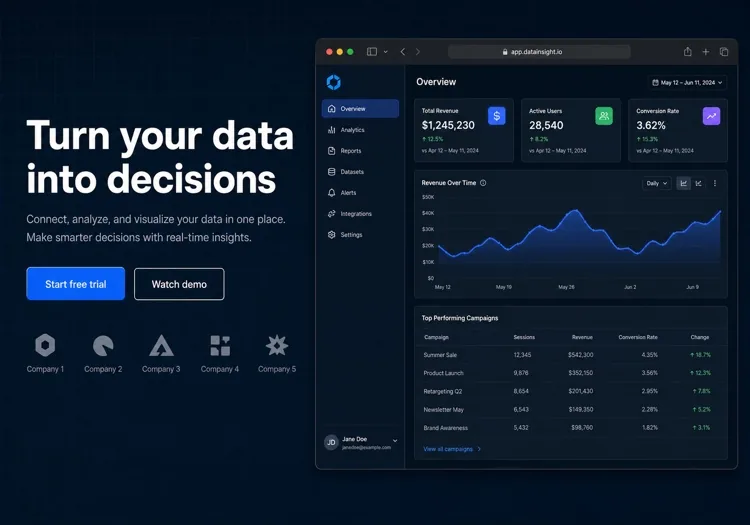
The default B2B SaaS hero. It works because the screenshot answers "what is this" while the headline is still being read — an abstract illustration in that slot leaves the visitor guessing.

Create a split-screen hero section: a left column with an eyebrow label, an H1 of six to ten words naming the outcome, a two-line subheading, a primary "Start free trial" button and a subordinate ghost "Watch demo" button, and a row of five grayscale customer logos underneath. The right column holds a product screenshot inside a browser chrome frame, rendered at an explicit width and height so it never shifts the layout, eagerly loaded and marked as the LCP image with a low-quality blur placeholder behind it. Stack to a single column below 1024px with the screenshot after the copy, and reduce the H1 by one step on mobile.
Teste no MeDo
CenteredMega

Centered Headline With a Logo Wall

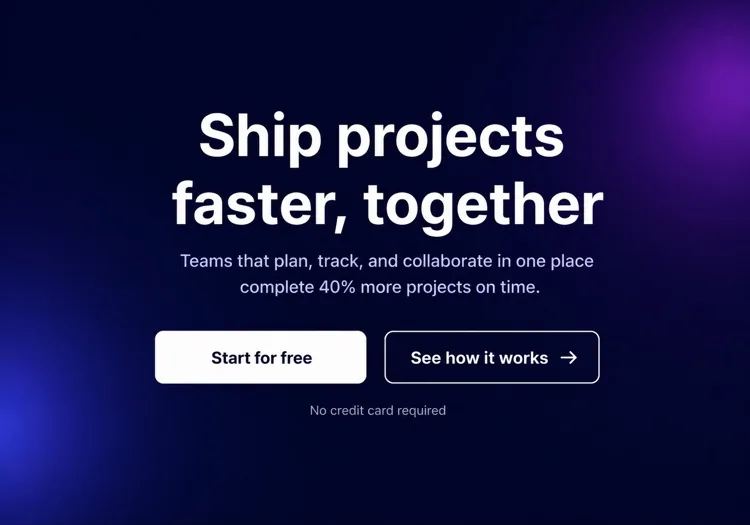
One column, everything on the axis, proof directly beneath the buttons. Reach for it when you have no screenshot worth showing yet but do have recognisable customers.

Create a centered hero section on a single column with a max width of 48rem: a small pill badge announcing a launch, an H1 of seven to nine words, a supporting paragraph of no more than two lines, then one primary button with a quiet text-link secondary beside it. Below that, a one-line trust note and a wall of six monochrome customer logos at reduced opacity that lifts to full on hover. Keep everything above 720px of viewport height on a laptop. On mobile, drop to four logos in two rows and make the primary button full width.

Teste no MeDo
TerminalShipfast

Developer Hero With an Install Command

For dev tools the install line is the CTA. A "Book a demo" button in this hero reads as enterprise friction and gets skipped by exactly the audience you wanted.

Create a developer-tool hero section: a left column with a GitHub star count chip, an H1 stating the problem in plain language, one line of supporting copy, and a monospace install command in a bordered box with a copy-to-clipboard button that switches to a "Copied" state for two seconds. Beside it, a secondary link to the docs. The right column shows a syntax-highlighted code block with a filename tab, pre-rendered as static markup rather than a client-side highlighter. Single column under 900px with the code block collapsing to a horizontally scrollable pane.

Teste no MeDo
Full bleedStudio

Full-Bleed Image Hero With Overlay Copy

An agency and consumer-brand staple. The risk is legibility: text over a photograph needs a gradient scrim, not a hopeful guess about how dark that corner of the image is.

Create a full-bleed hero section with a background photograph covering the viewport width at a fixed 70vh height on desktop and 60vh on mobile. Serve the image at responsive widths with a srcset, load it eagerly as the LCP element, and lay a bottom-up dark gradient scrim over it so overlaid text keeps at least 4.5:1 contrast regardless of the photo. On top, left-aligned: an H1 of five to eight words in large tight-tracked type, one line of positioning copy, and a single outlined white button. No secondary action. Add a reduced-motion-safe fade-in on the copy only.

Teste no MeDo
TypographicBuilders

Oversized Type, No Imagery

No image means no LCP image — the largest paintable element is text, which is the fastest hero you can ship. Use it when the positioning line is strong enough to carry the fold alone.

Create a typographic hero section with no imagery: an H1 spanning most of the container width at a fluid clamp between 2.5rem and 6rem with tight leading and negative letter spacing, broken deliberately across three lines. Underneath, a single supporting sentence at body size in a muted tone, then one primary button and a text link. Add a thin rule and a small row of three metrics with labels at the bottom of the section. Since the H1 is the LCP element, self-host the display font with font-display: swap and preload it. Reflow the H1 to smaller steps at 768px and 480px.

Teste no MeDo
Form-firstBrand*

Hero With an Inline Signup Form

Puts the conversion step in the fold instead of linking to it. Worth the extra complexity only when the form is one field — a three-field hero form converts worse than a button.

Create a hero section with an inline signup form: centered copy with an H1 of six to nine words and a one-line subheading, then a single-field form on one row — an email input with a visible label, a submit button reading "Get early access", and a helper line about no spam. Handle three states inline: idle, submitting with a disabled button and spinner, and a success message that replaces the form while keeping the container height stable. Show validation errors under the input, associated by aria-describedby. Stack input above button below 640px and keep both full width.

Teste no MeDo

Como personalizar seu Hero Section

Comece pelo resultado que seu usuário já deseja

Os melhores títulos de hero nomeiam o estado final que o visitante já persegue — "Lance mais rápido", "Durma tranquilo sabendo que seus dados estão seguros", "Corte seus gastos com ads pela metade". Pule o que seu produto é; comece com o que ele faz por eles. Você pode explicar o como no subtítulo.

Use um único CTA principal impossível de ignorar

Cada elemento na hero section deve direcionar o olhar para um botão principal. Oferecer três links com peso igual divide a intenção e mata cliques. Se precisar de uma opção secundária (ex.: "Ver demo"), faça-a visualmente subordinada — estilo ghost, menor ou apenas texto.

Ancore credibilidade com uma faixa de prova social compacta

Uma fileira de logos de clientes reconhecíveis, uma linha de estatísticas curta ("Confiança de mais de 12.000 equipes") ou uma avaliação com estrelas logo abaixo do CTA atua como ponto de prova silencioso. Reduz a hesitação "isso é legítimo?" sem tirar o foco da mensagem principal.

Mostre o produto, não uma ilustração abstrata

Um screenshot recortado ou mockup animado do produto real dentro de um frame de navegador ou dispositivo converte melhor que uma foto de banco genérica ou elemento decorativo. Visitantes querem saber no que estão se inscrevendo — mostrar a interface responde essa pergunta antes de precisarem perguntar.

Quem usa o componente Hero Section

Landing page de produto SaaS

Hero sections de SaaS tipicamente combinam um título curto orientado ao benefício com screenshot do produto ou mockup de dashboard, CTA de teste grátis e uma fileira de logos de clientes — dando aos visitantes contexto suficiente para se inscrever sem rolar.

Ferramenta para desenvolvedores ou projeto open-source

Heroes de ferramentas dev são técnicos: um título em negrito com a declaração do problema, um snippet de código ou bloco de terminal mostrando a integração-chave, contagem de estrelas no GitHub e um comando npm install como CTA principal.

Agência ou estúdio criativo

Heroes de agências priorizam impacto visual — fundos de vídeo full-bleed ou grandes tratamentos tipográficos, uma declaração de posicionamento em uma linha e um único CTA "Veja nosso trabalho" ou "Solicite um orçamento" com texto mínimo ao redor.

E-commerce ou produto de consumo

Heroes de produtos de consumo combinam fotografia de estilo de vida com título emocional atrativo, uma breve linha de características e um botão "Adicionar ao carrinho" ou "Comprar agora" — frequentemente acompanhado de oferta por tempo limitado ou nota de frete grátis.

Padrões de Hero Section para diferentes sites

O mesmo componente hero section, ajustado ao tipo de site em que ele entra.

01 / 06

SaaS Product Hero

Split layout, product screenshot on the right, free-trial CTA and a logo strip. The screenshot is the whole argument here, so crop it to one legible screen rather than shrinking the full dashboard until every label is unreadable.

Estilos e variações de Hero Section

Escolha a variação que combina com o resto da página e gere-a.

01 / 06

Split-Screen Hero

Copy on one side, visual on the other, at roughly a 50/50 or 60/40 split. The most forgiving layout because the text column keeps a natural measure. Decide explicitly whether the image or the copy comes first when it stacks — usually copy.

Hero Section em React, Next.js, Vue e Svelte

React, Next.js, Vue 3, SvelteKit, Astro ou HTML puro — o mesmo hero section, seis formas de integrar.

01 / 06

React Hero Section

A plain function component — a hero has no state unless it carries a form or carousel. Take the headline, subheading and CTA labels as props so the same hero serves several campaign pages.

src/components/Hero.tsx

export function Hero({ title, subtitle, cta }) {
  return (
    <section className="grid gap-10 py-24 lg:grid-cols-2">
      <div>
        <h1 className="text-5xl font-semibold">{title}</h1>
        <p className="mt-4 text-lg text-zinc-400">{subtitle}</p>
        {cta}
      </div>
      <img src="/product.png" alt="" width={960} height={640} />
    </section>
  )
}

Como adicionar o seu Hero Section a um projeto

Quatro passos, de escolher um modelo de hero section até subir para produção.

01~30s

Pick a Hero Template

Choose by what you actually have to show: a screenshot means split-screen, recognisable customers mean centered with a logo wall, neither means typographic.

02~10s

Copy the Prompt

Take the prompt into MeDo, Lovable, Bolt, v0 or Cursor. Replace the placeholder headline with your real one before you run it — the layout is decided by how long that line is.

03~2min

Generate and Refine

You get React + Tailwind back with a live preview. Follow up in plain English — "make the secondary button a text link", "tighten the H1 tracking" — rather than editing class strings by hand.

04~1min

Place It Above the Fold

Drop it in as the first section after your header, swap the placeholder for a real image with explicit dimensions and eager loading, and confirm the page still has exactly one h1.

Perguntas comuns sobre Hero Section

O que é um gerador de hero section com IA?

Um gerador de hero section com IA é uma ferramenta que recebe uma descrição em linguagem natural do seu produto, público e estilo e produz um hero completo above-the-fold — título, subtítulo, botões CTA e código estilizado pronto para produção. O MeDo gera o componente completo incluindo layout, tipografia, cores e comportamento responsivo, não apenas um stub de código.

Como criar uma hero section com IA?

Abra o MeDo e descreva o que está construindo: o produto, o público-alvo, o tom e quaisquer preferências visuais. Por exemplo: "Hero section para um app de faturamento freelance voltado para designers — fundo branco limpo, título em negrito sobre receber pagamentos no prazo, um CTA principal e screenshot do produto à direita." O MeDo gera a seção; você pode refiná-la com prompts de seguimento para ajustar texto, layout ou cores.

O que uma hero section deve incluir?

Uma hero section forte precisa no mínimo: um título que declare a proposta de valor central em uma linha, um subtítulo que adicione contexto ou prova, um botão CTA principal com rótulo orientado ao resultado e um visual de apoio (screenshot, ilustração ou vídeo). Heroes de alto desempenho também incluem um breve sinal de confiança — contagem de clientes, faixa de logos ou menção na imprensa — para reduzir o ceticismo inicial.

Qual é a melhor ferramenta de IA para gerar hero sections?

O MeDo é construído especificamente para gerar componentes UI individuais a partir de prompts em linguagem natural, incluindo hero sections. Diferente de ferramentas de chat IA genéricas, o MeDo entende padrões de conversão de landing pages, melhores práticas de acessibilidade e estrutura de componentes — então o resultado é realmente utilizável em produção, não apenas código de aparência plausível que precisa ser reescrito.

Qual deve ser o tamanho do título de uma hero section?

Os títulos de hero mais eficazes têm 5–10 palavras — curtos o suficiente para ler em uma olhada, específicos o suficiente para sinalizar exatamente para quem é o produto e o que ele faz. Evite jargão e superlativos. Se seu título precisa de ponto e vírgula ou segunda oração para fazer sentido, provavelmente são dois títulos: escolha o mais forte.

Posso gerar diferentes estilos de hero section com IA?

Sim. O MeDo suporta qualquer layout ou estilo visual que você possa descrever — texto centralizado com fundo gradiente, divisão texto-esquerda/imagem-direita, hero de vídeo full-bleed, hero tipográfico minimalista, vitrine de produto em dark mode e mais. Inclua o estilo visual no seu prompt, ou peça ao MeDo para gerar duas ou três variantes para comparar antes de escolher.