MeDo

Gerador de inscrição em newsletter com IA.

Transforme um briefing de uma frase em uma seção de inscrição em newsletter polida. Campo de email, copy de apoio, prova social e código estilizado — tudo gerado e pronto para o deploy.

Inscrição na newsletter

Sua lista de email é o único público que você realmente possui

Algoritmos sociais mudam, custos de anúncios sobem e o alcance das plataformas decai — mas uma lista de assinantes de email cresce ao longo do tempo e pertence inteiramente a você. Um componente de inscrição em newsletter bem projetado transforma visitantes passivos em um público direto baseado em permissão. Acertar o copy, o layout e a fricção neste momento é um dos investimentos de maior alavancagem que um site pode fazer.

6 modelos

Modelos de Inscrição na newsletter que você pode gerar

Cada modelo é um prompt real, não uma captura de tela. Copie para qualquer editor de IA, ou rode no MeDo e receba código React + Tailwind.

CenteredAcme

Centered Section With One Field

The default: headline, one line of value exchange, email, button. One field is the whole design decision — asking for a first name alongside the email buys you a merge tag and costs you subscribers.

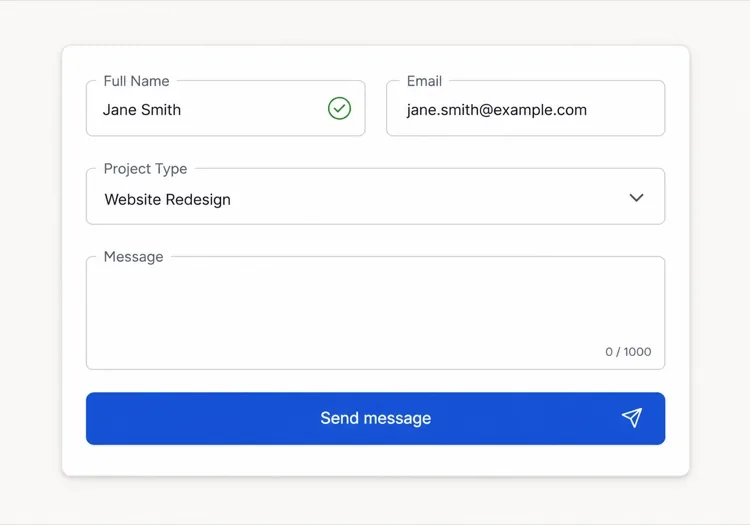
Create a centered newsletter signup section with generous vertical padding: a headline naming the topic and the cadence, one supporting line describing exactly what arrives and how often, then an inline form with a single email input and a Subscribe button sitting flush beside it on desktop and stacked full-width on mobile. Use type="email", autocomplete="email", inputmode="email" and a visually hidden label. Validate on blur and on submit rather than on every keystroke, showing the message in an element referenced by aria-describedby with aria-invalid on the field. Disable the button and swap its label to a spinner while submitting, then replace the whole form with a confirmation message asking the reader to check their inbox.
Teste no MeDo
InlineInline

In-Article Capture Strip

A compact strip dropped mid-post, where the reader has already decided the writing is worth their time. Catches intent that a footer form never sees, but it has to stay short — a full section mid-article reads as an interruption.

Create a compact inline newsletter strip for placement mid-article: a tinted rounded panel about the width of the article column, with a one-line bold prompt referencing the topic of the surrounding post, a short second line naming the cadence, and a single-row form with an email input and a short button label. No heading larger than the article body headings, so it does not read as a new section. Validate inline on blur with the error text replacing the cadence line rather than growing the panel, keep the panel height fixed across default, error and success states, and on success swap the form for a one-line confirmation in place.

Teste no MeDo
Split panelMega

Two-Column Panel With a Sample Issue

Copy and form on one side, a preview of a real issue on the other. Showing the thing itself outperforms describing it — a reader who can see the format does not have to trust your adjectives.

Create a two-column newsletter signup panel: on the left, a headline, three short bullet points naming what each issue contains, the email form and a muted no-spam line; on the right, a framed screenshot or rendered preview of a recent issue with a link to read it in full before subscribing. Give the right column a fixed aspect-ratio box so the panel does not reflow while the preview image loads. Keep the form to one input plus a button, with inline validation on blur and an aria-live region for the result. Stack to one column on mobile with the preview below the form, and lazy load the preview image.

Teste no MeDo
Lead magnetShipfast

Signup Traded for a Download

The email buys a specific artefact rather than a subscription. It converts colder traffic, and it fills your list with people who wanted the file — say plainly that the newsletter continues after it.

Create a lead-magnet signup section: a thumbnail of the asset on the left, and on the right a headline naming the asset concretely, a line stating its format and length, an email input with a Send it to me button, and a small line stating that subscribers also receive the weekly email so the ongoing commitment is not a surprise. Add a required consent checkbox with the wording as a visible label rather than a tooltip, and block submission with an inline message if it is unchecked. On success, show a confirmation that names the sending address and asks the reader to confirm the double opt-in email before the download link arrives.

Teste no MeDo
Social proofStudio

Subscriber Count With Reader Faces

A stacked avatar row and a real count above the form. It answers the fear of joining a dead list — but only with a true number, since a rounded-up count is the easiest kind of claim for a reader to disbelieve.

Create a newsletter signup section led by social proof: a stacked row of five overlapping reader avatars with a plus-N chip, then a line stating the subscriber count and who they are, then the headline, then the form. Below the button, a two-item reassurance row covering unsubscribe in one click and no sharing of addresses. Keep the form to one email field with inline validation on blur, aria-invalid on the field and the message wired via aria-describedby. Give the avatars explicit width and height so the row does not shift as images load, and render a confirmation state in place of the form on success rather than a toast.

Teste no MeDo
Footer barAnchor

Persistent Bottom Capture Bar

A slim bar pinned to the bottom of the viewport after a scroll threshold. The lowest-friction placement and the easiest one to overdo — one dismissal must be remembered, or it stops being a form and becomes a nuisance.

Create a slim newsletter capture bar fixed to the bottom of the viewport, revealed once the reader passes about 60% scroll depth and animated in with a short translate. It holds one line of copy, an email input, a short button and a labelled dismiss button. Persist the dismissal in localStorage so it never returns for that reader, and hide it entirely for anyone already subscribed. Show validation errors as a tooltip above the input rather than growing the bar, keep the bar under 72px tall, add bottom padding to the page so it never covers the final content, respect prefers-reduced-motion, and collapse to a single tap target that expands into the form on mobile.

Teste no MeDo

Como personalizar seu Inscrição na newsletter

Nomeie exatamente o que o assinante recebe e quando

CTAs vagos como "Assine nossa newsletter" performam mal. Substitua por especificidade: "Uma tática de crescimento acionável toda sexta" ou "Estudos de caso semanais para fundadores independentes". Quanto mais precisamente você descrever a cadência e formato do conteúdo, mais fácil será para o leitor certo dizer sim.

Adicione contagem de assinantes como prova social

Uma única linha — "Junte-se a 12.000 leitores" ou "Confiado por 4.500 desenvolvedores" — posicionada abaixo do botão de inscrição elimina o medo de se inscrever em algo que ninguém lê. Mesmo um número real modesto supera nenhum número, porque sinaliza que a lista está viva.

Reduza o formulário a um único campo

Pedir nome junto com email aumenta a taxa de abandono. Comece apenas com email. Personalização pode acontecer depois que o assinante estiver no funil. Cada campo extra é um motivo para ir embora.

Ofereça um lead magnet para visitantes de baixa intenção

Para públicos que precisam de mais convencimento, combine o formulário de inscrição com um brinde concreto: uma checklist gratuita, uma edição de amostra ou um recurso exclusivo. Uma pequena recompensa imediata converte visitantes indecisos que de outra forma iriam embora sem se inscrever.

Quem usa o componente Inscrição na newsletter

Blog de produto SaaS

Blogs de produto inserem inscrições em newsletter inline no meio do artigo e no final dos posts, tipicamente oferecendo um digest de novos artigos ou uma lista curada de ferramentas — capturando leitores no momento em que estão mais engajados com o conteúdo.

Criador independente ou escritor

Sites de solopreneurs centralizam toda a homepage em torno de uma inscrição em newsletter, liderando com um gancho pessoal ousado — o tema específico e cadência — e usando uma contagem real de assinantes como sinal primário de credibilidade.

E-commerce ou marca DTC

Sites de varejo usam inscrições em newsletter para oferecer desconto na primeira compra, depois nutrem assinantes com lançamentos de produtos, reposições e campanhas sazonais — transformando a lista de email em um canal de receita direto.

Ferramenta para desenvolvedores ou projeto open-source

Newsletters voltadas para desenvolvedores prometem notas de release, resumos de changelogs e análises técnicas aprofundadas. Inscrições nesses sites são mínimas — campo de email, descrição de uma linha e botão de envio — porque o público valoriza substância acima de estilo.

Padrões de Inscrição na newsletter para diferentes sites

O mesmo componente inscrição na newsletter, ajustado ao tipo de site em que ele entra.

01 / 06

SaaS Product Blog Signup

Inline mid-article beats a footer form here, because the reader who is 60% through a technical post is the only one whose intent you can actually read. Promise the specific thing — release notes, or a monthly digest — not "our newsletter".

Estilos e variações de Inscrição na newsletter

Escolha a variação que combina com o resto da página e gere-a.

01 / 06

Centered Section

Headline, one supporting line, one field, one button, centred with wide padding. The safest default and the one that survives being dropped anywhere on the page, since it makes no assumption about the content around it.

Inscrição na newsletter em React, Next.js, Vue e Svelte

React, Next.js, Vue 3, SvelteKit, Astro ou HTML puro — o mesmo inscrição na newsletter, seis formas de integrar.

01 / 06

React Newsletter Signup

Model the form as one status value — idle, submitting, success, error — rather than three booleans, so the impossible states cannot render. Keep the input controlled so validation and the disabled button read from the same source.

src/components/NewsletterSignup.tsx

type Status = 'idle' | 'submitting' | 'success' | 'error'

export function NewsletterSignup() {
  const [email, setEmail] = useState('')
  const [status, setStatus] = useState<Status>('idle')

  if (status === 'success') return <p role="status">Check your inbox to confirm.</p>

  return (
    <form onSubmit={submit} noValidate>
      <input type="email" value={email} onChange={(e) => setEmail(e.target.value)} required />
      <button disabled={status === 'submitting'}>Subscribe</button>
    </form>
  )
}

Como adicionar o seu Inscrição na newsletter a um projeto

Quatro passos, de escolher um modelo de inscrição na newsletter até subir para produção.

01~30s

Pick a Signup Layout

Match the placement to the reader's state — inline mid-article for engaged readers, a centred section for a landing page, a split panel when showing a sample issue does the persuading.

02~10s

Copy the Prompt

Take the prompt into MeDo, or paste it into Lovable, Bolt, v0 or Cursor. Write the real value exchange first — topic, cadence, what arrives — because "Subscribe to our newsletter" is the line that costs you the signup.

03~1min

Generate and Refine

You get React + Tailwind back with a live preview. Follow up in plain English — "add a consent checkbox", "show the error under the input", "keep the panel height fixed across states" — rather than editing markup by hand.

04~2min

Wire It to Your List

Post to your provider from a server action or API route so the token never reaches the browser, turn on double opt-in, and check the success, error and already-subscribed states before shipping.

Perguntas comuns sobre Inscrição na newsletter

O que é um gerador de inscrição em newsletter com IA?

Um gerador de inscrição em newsletter com IA é uma ferramenta que recebe uma descrição em linguagem natural da sua newsletter — tema, público e incentivo — e produz um componente de inscrição completo com copy, layout, campo de email e código estilizado. MeDo gera o componente completo incluindo título, subtexto, campo de input, botão e linha de prova social em um único prompt.

Como criar um formulário de inscrição em newsletter com IA?

Abra MeDo e descreva sua newsletter em linguagem natural: para quem é, o que cobre, com que frequência é enviada e qual lead magnet você oferece. Por exemplo: "Crie uma inscrição em newsletter para um email semanal sobre finanças pessoais para millennials — inclua um título, uma descrição de duas linhas, um campo de email e um botão de inscrição." MeDo gera o componente; você pode refinar estilo e copy com prompts de follow-up.

O que uma boa seção de inscrição em newsletter deve incluir?

No mínimo: um título específico nomeando o tema e cadência, uma ou duas linhas de copy de apoio, um campo de email e um botão de inscrição claro. Inscrições de alta performance também incluem contagem de assinantes como prova social, uma linha de garantia de privacidade ("sem spam, cancele a qualquer momento") e opcionalmente uma menção ao lead magnet acima do formulário.

Qual é a melhor ferramenta de IA para gerar componentes de inscrição em newsletter?

MeDo é construído especificamente para gerar componentes de UI a partir de prompts, incluindo inscrições em newsletter. Ao contrário de ferramentas de chat genéricas, MeDo entende padrões de conversão, estrutura de componentes e acessibilidade — então a saída está pronta para produção em vez de ser um ponto de partida bruto que precisa de limpeza extensiva.

Como posso aumentar as taxas de conversão de inscrição em newsletter?

As três mudanças de maior impacto são: substituir CTAs vagos por promessas de conteúdo específicas, adicionar uma contagem real de assinantes como prova social e reduzir o formulário a um único campo de email. Além disso, posicionamento importa — inscrições inline no meio do artigo consistentemente superam formulários apenas no rodapé porque capturam leitores enquanto estão engajados.

A IA pode escrever o copy da minha inscrição em newsletter também?

Sim. MeDo gera tanto o código do componente quanto o copy dentro dele — título, subtítulo, label do botão e texto de prova social — baseado no seu prompt. Você pode pedir para reescrever o copy com um tom diferente, inserir uma contagem real de assinantes ou testar títulos alternativos sem tocar no código.